
On Monday I reported here how Michi HB9EIY connected our repeater HB9TG to the FM-Funknetz. By now I’m on the network myself, straight from the Mac. I installed JaYTrX-Desk, put the Swiss talkgroups on the monitor list and let the scan run. It worked first time. What really surprised me was the audio: it sounds a good deal better than DMR.
That made me wonder: what actually is this FM-Funknetz? Who runs it, how does it work, and why are there numbered talkgroups like in DMR? Here is what I found.
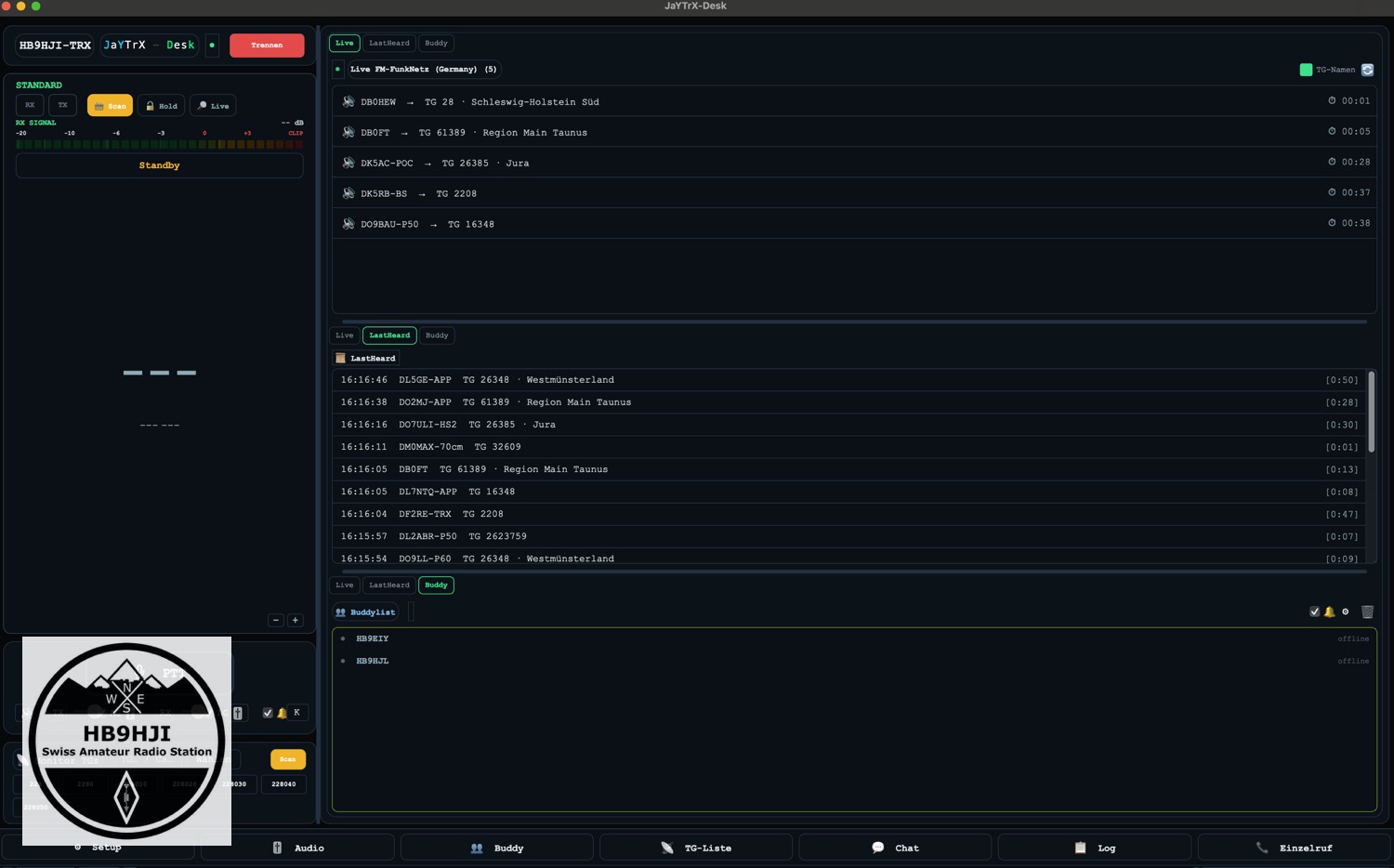
From Thuringia to the whole German-speaking area
It all started at the end of 2015 as the «Relaisverbund Thueringen.link», a repeater network from the German state of Thuringia. In 2016 it went on air with six repeaters and a few simplex access points. The idea behind it will be familiar to all of us: analogue repeaters were getting quieter and quieter. DMR, D-STAR and C4FM had long had talkgroups and reflectors, while FM only had EchoLink.
The name soon stopped fitting. By 2018 the network already reached from Aachen to Leipzig and from the Baltic coast to the Zillertal in Austria. In 2022 it became the FM-Funknetz. At the start of 2025 more than 400 stations were connected. I looked at the dashboard today: in the last seven days 1,056 callsigns with just over 1,500 devices were active, with 155,000 transmissions and 600 hours of talk time between them. This is no longer a niche project.
The network was founded by Jens, DJ1JAY, who is still the master sysop. A small team looks after registrations, the wiki, the technology and the software. The whole thing is run privately and free of charge, funded by donations. JaYTrX, the app and the Desk, is also by Jens.
The technology: SvxLink and a reflector
At the heart of the network is SvxLink. Tobias Blomberg, SM0SVX, from Sweden started the software in 2003 as an EchoLink program for Linux. Today it is a complete repeater controller with repeater and simplex logic, DTMF commands and modules. The SvxReflector arrived in 2017, talkgroups in 2019.
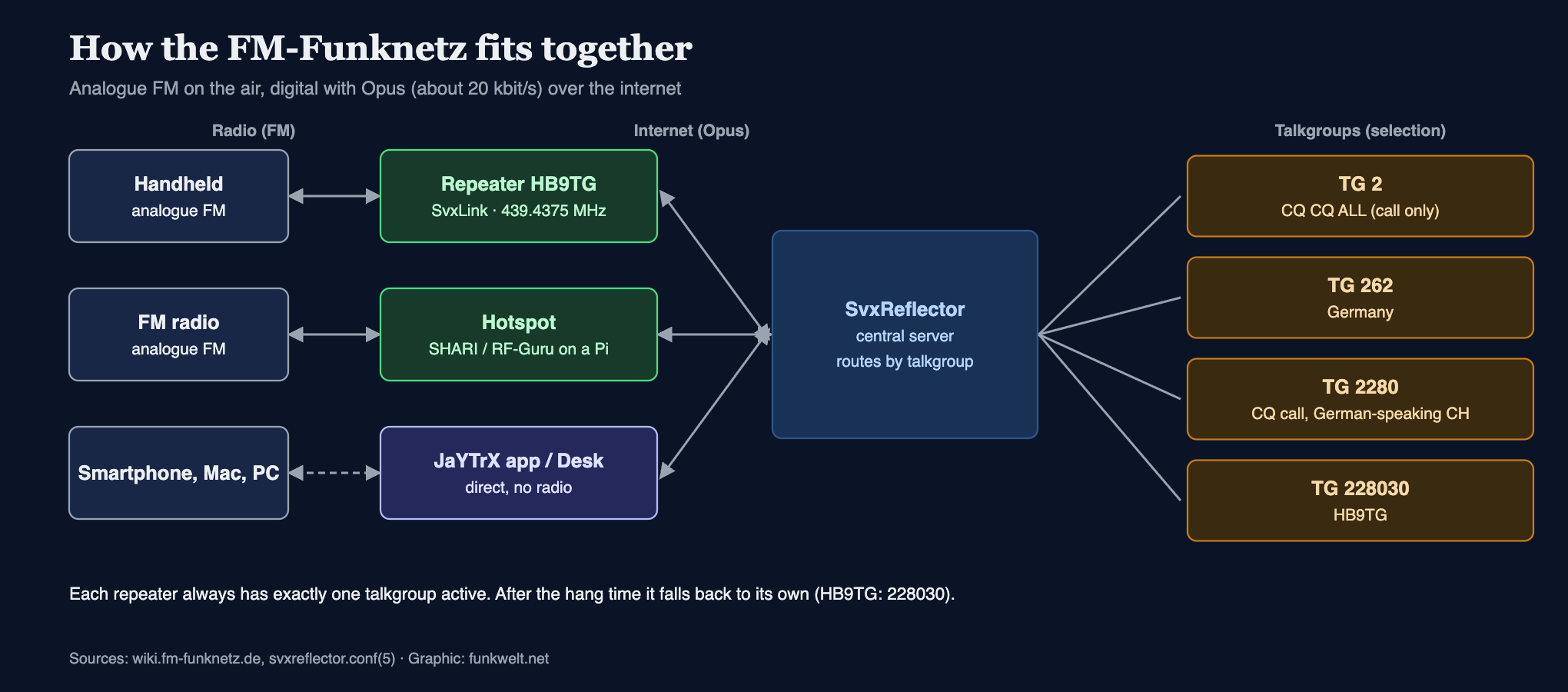
The structure is simple. Every repeater and every hotspot has a small computer running SvxLink, usually a Raspberry Pi. It connects to the central reflector over the internet. The reflector does not send the audio to everyone, only to the stations in the same talkgroup. Each repeater always has exactly one talkgroup active. After the hang time it falls back to its own, which for HB9TG is 228030.
Why it sounds better than DMR
On the air it is plain analogue FM. Only between the repeater and the reflector is the audio sent digitally, using the Opus audio codec. You may know it from video calls. In the SvxReflector it runs at about 20 kbit/s by default.
DMR has to squeeze speech down to 2,450 bits per second, which is the job of the AMBE+2 vocoder. So Opus has about eight times as much data to work with, and you can hear it. On top of that, when the signal gets weak, FM just gets a little noisy. There is no robot voice and no chopped-up syllables.
Where do the numbers come from?
Anyone who sees the talkgroups immediately thinks of DMR. That is no coincidence. The numbers are modelled on DMR, even though the two networks have nothing to do with each other. Their roots are not in amateur radio at all, but in mobile telephony.
Every SIM card carries a Mobile Country Code, or MCC. The ITU defines the country codes in its E.212 standard: 228 stands for Switzerland, 262 for Germany and 232 for Austria. DMR adopted this scheme for user IDs and country groups. The SvxReflector manual even explicitly recommends starting talkgroups with the country’s MCC.
From there the numbers get more specific from left to right. For us it looks like this:
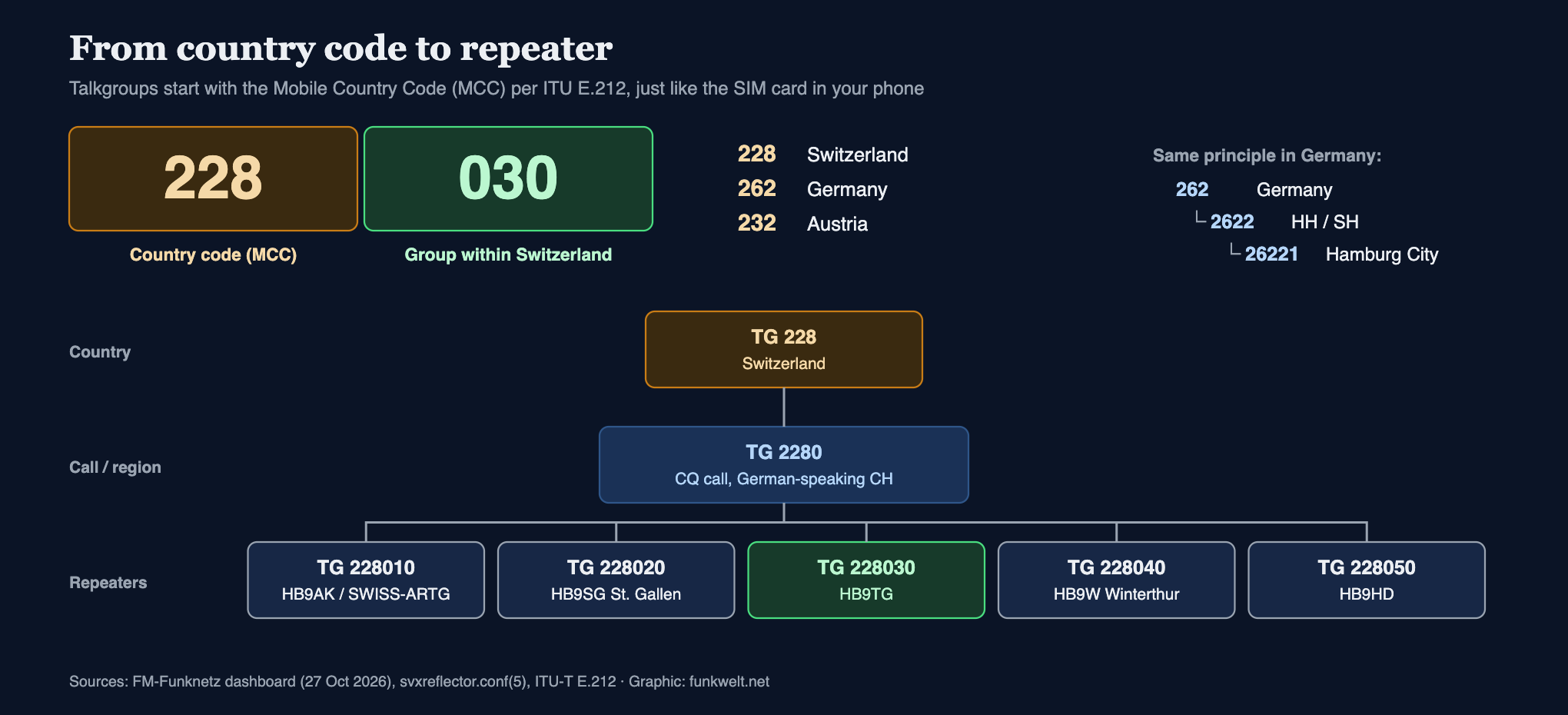
There are a few special numbers too: TG 2 is only for the CQ call, after which you move to another group. TG 20 is for tests, and on 9990 you hear yourself as an echo. Unlike DMR, you don’t need a codeplug. You select a talkgroup by DTMF with 91, the number and #, so for the Swiss call it is 912280#.
The Swiss talkgroups
This is my monitor list in JaYTrX-Desk, which puts all the Swiss groups on my screen:
| TG | Name |
|---|---|
| 228 | Switzerland |
| 2280 | CQ call, German-speaking Switzerland |
| 228010 | HB9AK / SWISS-ARTG |
| 228020 | HB9SG section St. Gallen |
| 228030 | HB9TG |
| 228040 | HB9W section Winterthur |
| 228050 | HB9HD high-frequency digital group |
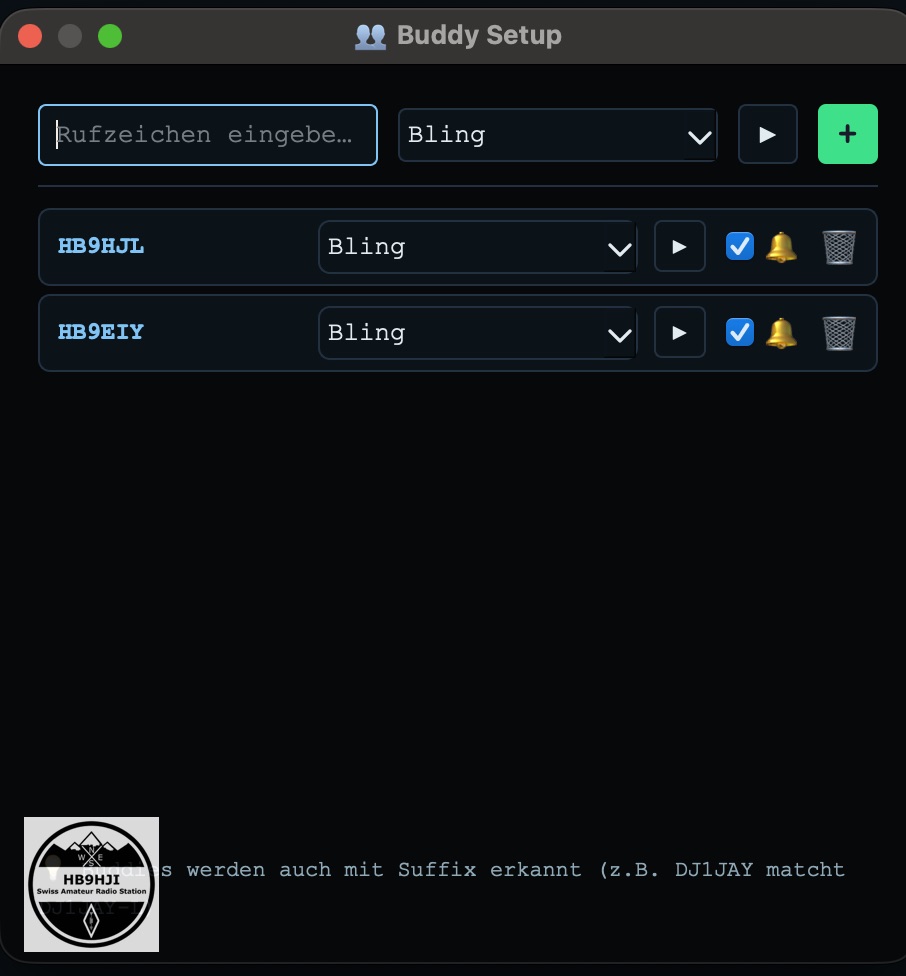
Not many Swiss repeaters are connected yet. For a long time there were only HB9AK in Schleitheim, HB9AK-L on the Hörnli and HB9SG on the Hohe Buche. That makes me all the happier about HB9TG. If you call on 2280, the whole of German-speaking Switzerland hears you.
How to join
Only licensed radio amateurs may transmit, but anyone may listen. You have three options:
- Via a connected repeater: any FM radio with CTCSS and DTMF will do, and no registration is needed. How it works at HB9TG is in my post about Michi’s repeater.
- With your own hotspot: for example a SHARI or RF-Guru module on a Raspberry Pi. That can be done for under 100 euros. Some Linux knowledge helps, and the wiki and forum have guides and ready-made images.
- With an app or desktop program: JaYTrX is available for Android, and the iOS version is due this year. JaYTrX-Desk runs on macOS, Linux and Windows. It can scan with priorities, shows LastHeard and a buddy list and has a chat. It is free, with no subscription and no ads.
For the hotspot, the app and the Desk you request access credentials via the FM-Funknetz ticket system. Mine arrived after six minutes, which really impressed me.
A few ground rules
- Give your callsign at the start. «Test123 ist kein Rufzeichen» (Test123 is not a callsign), say the rules.
- Leave two to four seconds between transmissions so others can break in.
- No politics, no insults, no VOX.
- Test on TG 20, not on 2280.
- Never additionally link a network repeater to another network repeater via EchoLink, or you create a loop.
My verdict after the first few days
The FM-Funknetz shows that FM is far from dead. You pick up your old handheld, call through the repeater down the road and end up in a network where more than a thousand callsigns are active every week. And it even sounds better than the digital modes. I’m curious to see how busy the Swiss groups get over the coming weeks.
Give it a call on 2280 or straight on 228030. I’m listening.
Links
- FM-Funknetz
- Dashboard: who is active in which talkgroup right now
- Ticket system: request access credentials
- FM-Funknetz wiki: technology and build guides
- JaYTrX app and JaYTrX-Desk
- Rules
- SvxLink
- SWISS-ARTG on the FM-Funknetz
73 de Chris, HB9HJI
Leave a Reply