
On 9 May 2026 I made the first commit for HAM-Tools. Just over six months have passed since, and on Saturday, 14 November, version 1.63 comes out with two new modules. A good moment to look back and count. And to thank the people without whom it would not have got this far.
The numbers
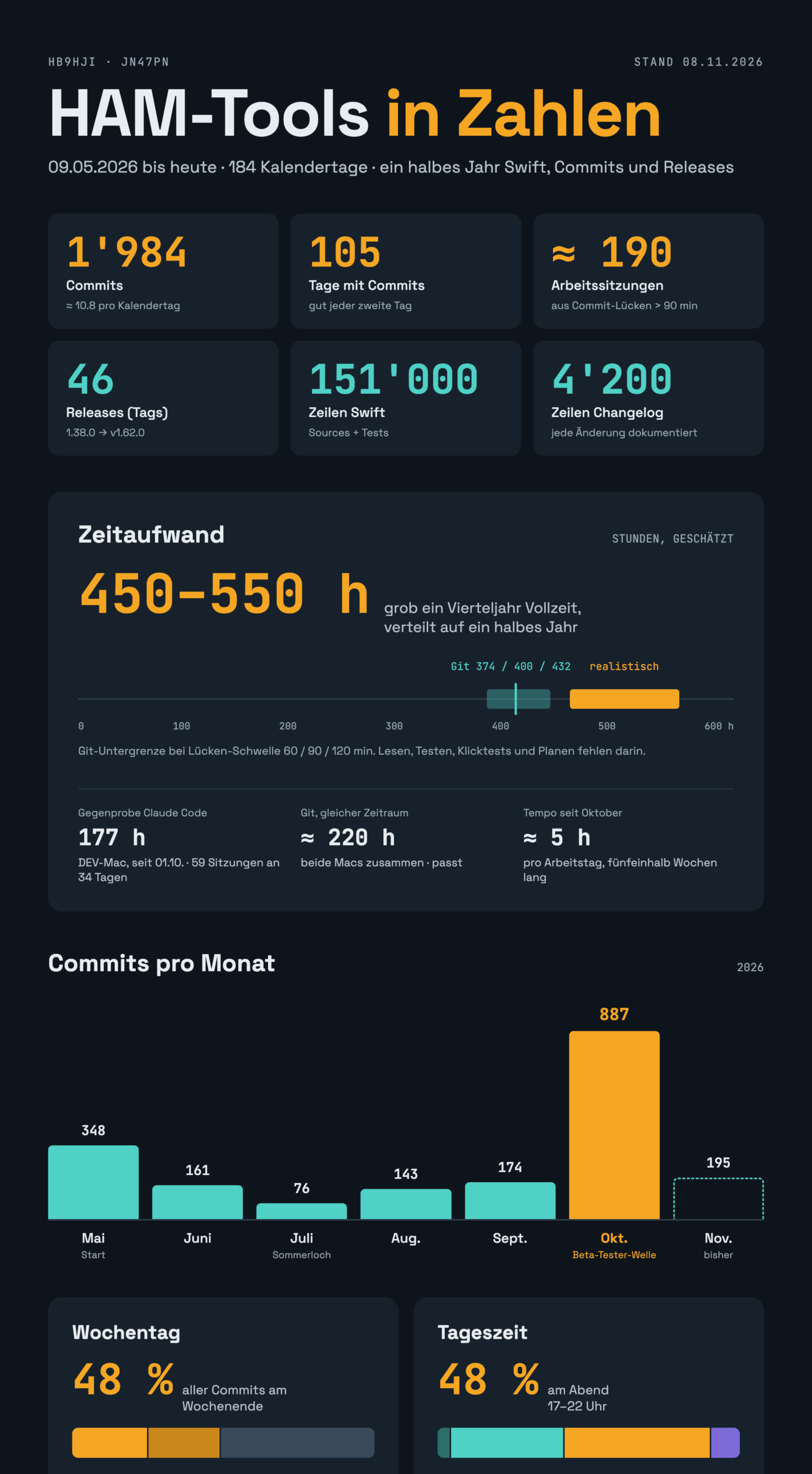
The Git repository forgets nothing. Since 9 May it has recorded:
- 2,041 commits, spread over 107 of 186 days
- 46 versions, from the very first one up to 1.62 last Friday
- 710 Swift files with around 152,000 lines of code
And how many hours are in there? I never had a stopwatch running. But the commit timestamps make for a fairly good estimate: commits close together belong to the same session, and each session gets a little lead time added. That comes to just over 400 hours. This only measures what left a commit behind. Reading, planning, click-testing at the radio and trying things out in the field come on top, so I put the realistic effort at 450 to 550 hours.
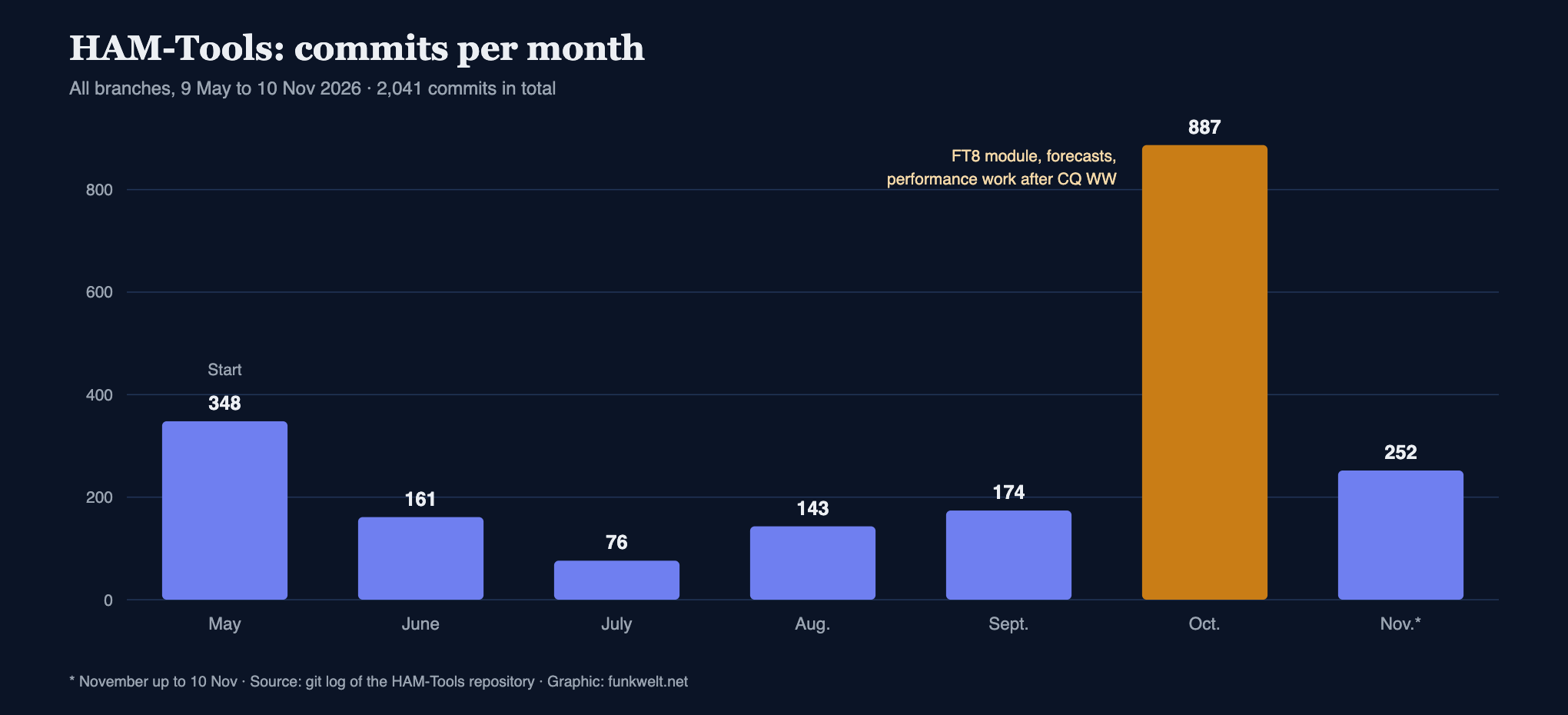
The curve tells its own story. May was the start, with a lot of groundwork, and things got quieter over the summer. Then October really took off: the FT8 module, the performance work after CQ WW and the forecasts. That month alone saw almost 900 commits.
New on Saturday: the Activation Planner
What question do I ask myself before every free weekend? «Where to on Saturday?» That is exactly what the new Activation Planner in 1.63 is for.
It shows the references of seven programmes on the map: POTA, SOTA, WWFF, BOTA, GMA, WCA and LLOTA. There are two ways to search:
- Radius: everything within 5 to 200 km of your location. Around my QTH in JN47PN, 25 km already gives over 200 results.
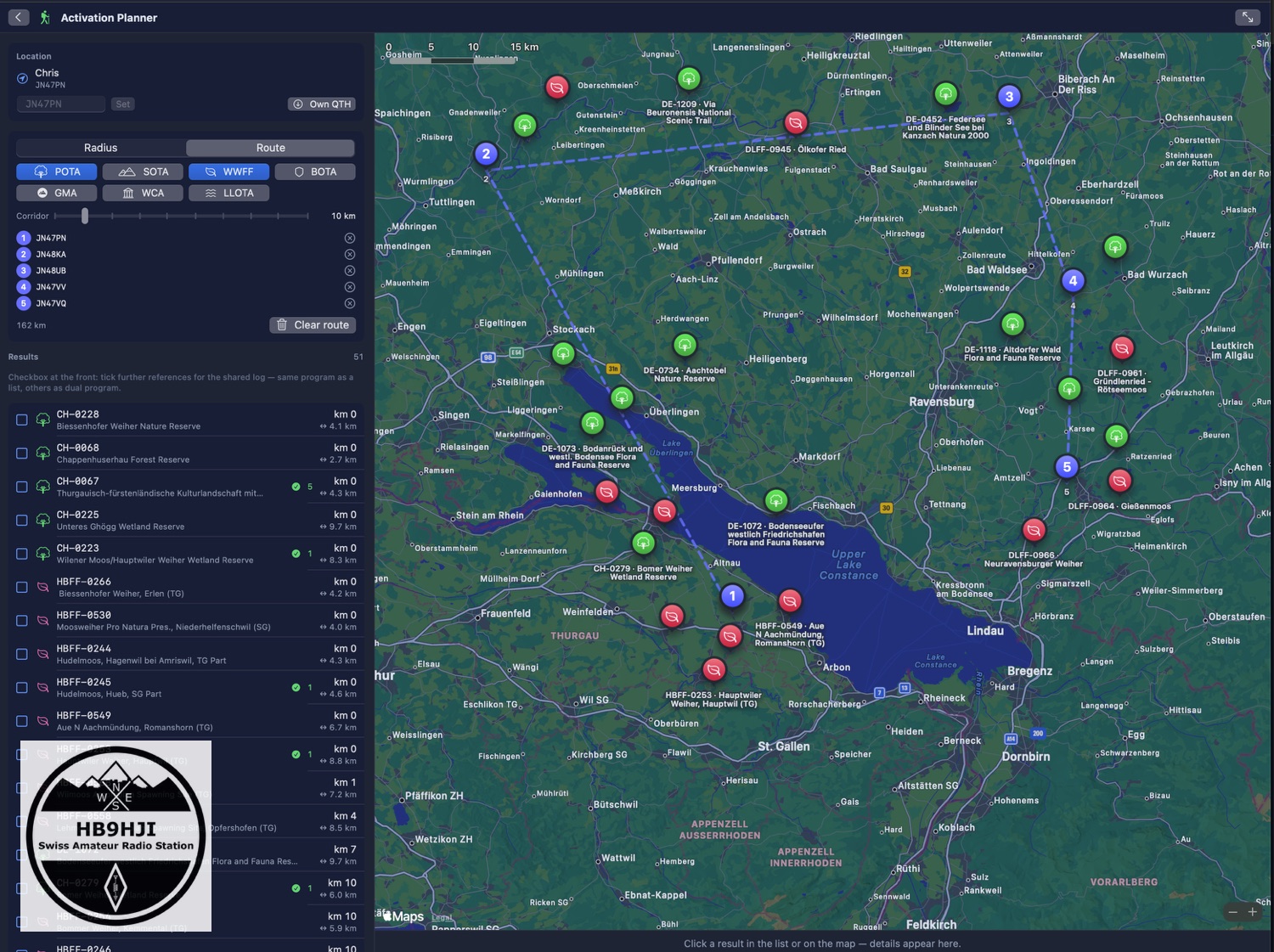
- Route: click waypoints on the map, and the planner searches a corridor either side of the route. Results are sorted by distance along the route. As an example, I planned a loop around Lake Constance: 162 km, 51 references along the way.
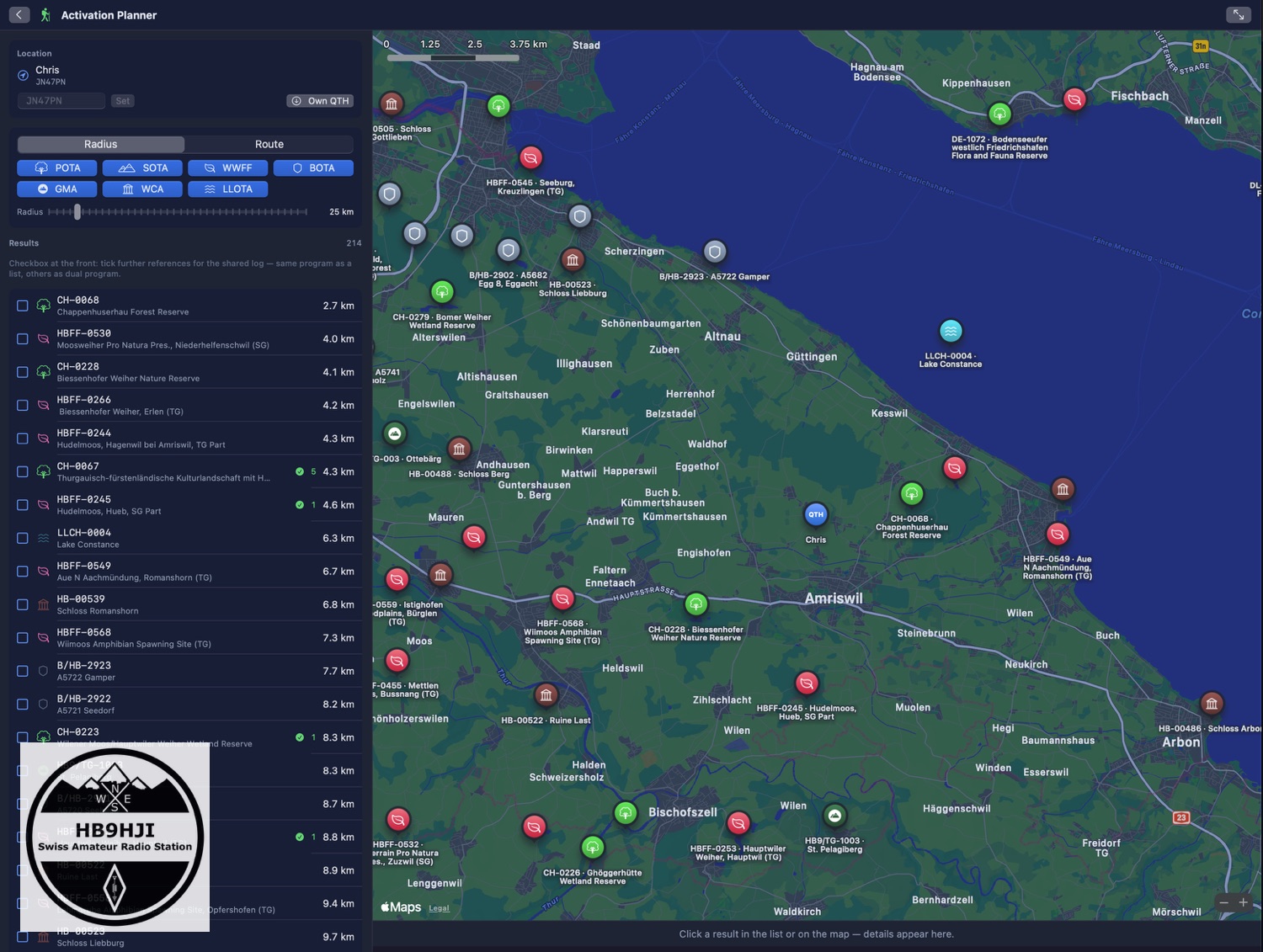
For each result the planner shows whether I have already activated it (a green tick with the count), when the sun rises and sets, and what propagation looks like at the destination right now. The location comes from your own locator or can be typed in, such as tomorrow’s campsite. One click creates the matching activation log, with several references if you like. A park and an overlapping WWFF area end up in one log that way. Everything runs offline; only the propagation needs a connection.
Two honest limitations: propagation applies to right now, there is no forecast for the activation day. And WWFF only allows one reference per activation.
New on Saturday: repeaters and channels
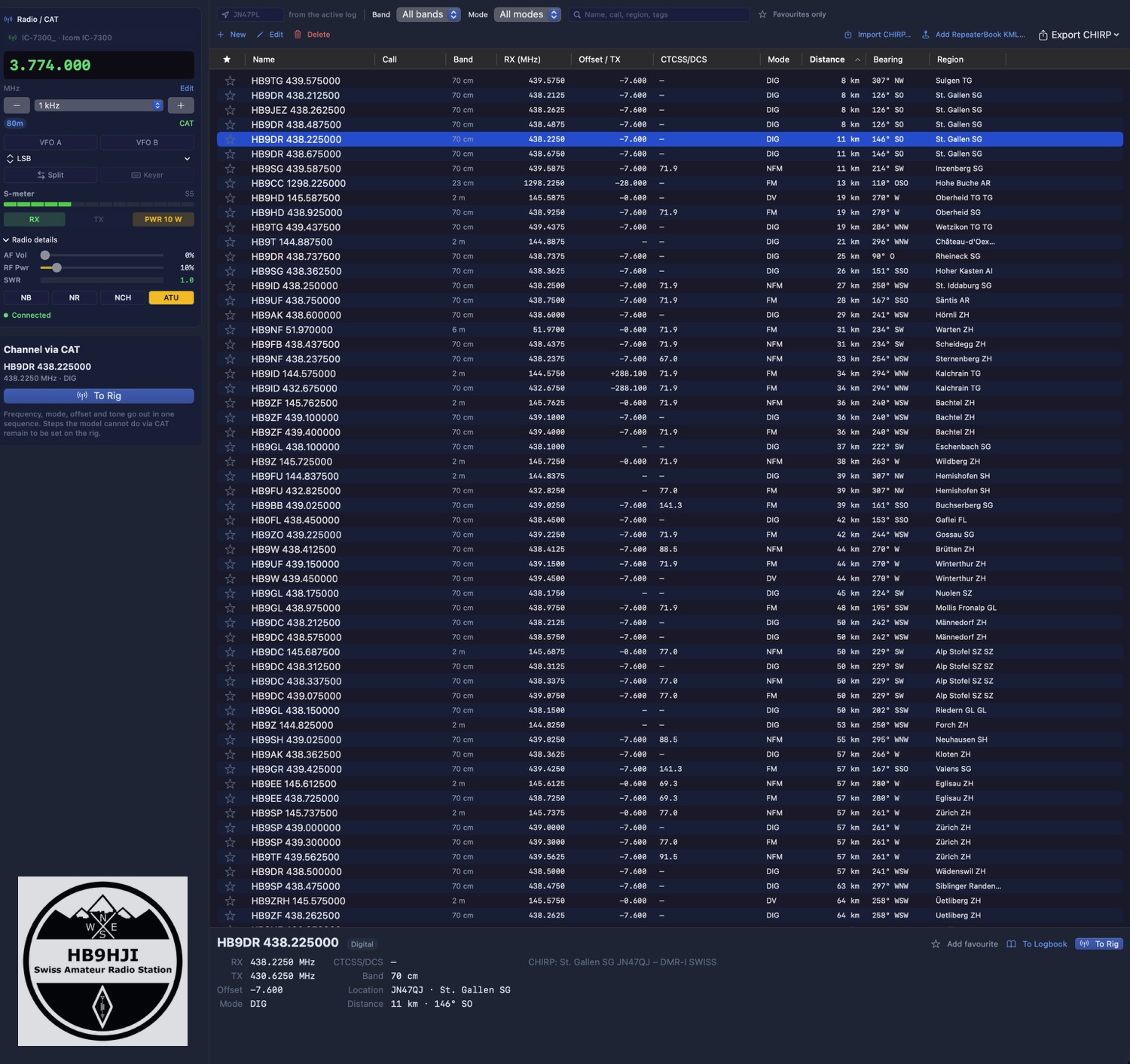
The second new module takes care of VHF and UHF. Repeaters & Channels shows repeaters and simplex channels from your current location, with distance and bearing, band and mode filters, search and favourites.
- CHIRP import and export: If you already maintain your channels in CHIRP, you can bring them in with a preview and get them back out unchanged. On re-import, favourites and your own notes are kept.
- To Rig: A double-click sets frequency, mode, offset and tone via CAT. Anything a radio cannot do via CAT, such as the repeater offset on the IC-7300, or DMR and C4FM, appears as a hint to «set on the rig».
- To Logbook: frequency, band, mode and the repeater callsign go into the log.
It has been tested with the IC-705 via USB and Wi-Fi, the IC-9700 and the FTX-1. For me this closes a circle: in my post on the new website of the USKA, the Swiss amateur radio association, I criticised that its repeater list could not be downloaded, and for the ID-51, CHIRP was the tool of choice. Now both work in one app.
Also in 1.63
- Winlink: ARDOP transmit level and «Tune» right in the window, as in the FT8 module. Until now you had to go into the settings.
- Look: tables, settings and maps now follow the app’s colour scheme instead of the grey macOS default.
- IC-705 via Wi-Fi: The connection dropped after a few minutes. We found the cause by comparing captures with wfview: the radio requests lost packets as a range, and HAM-Tools only sent the end points.
- Xiegu G90: CAT kept connecting and disconnecting in a loop because the radio takes longer for its first reply than the app was waiting.
By the way, what I announced last week has already come out with 1.62: the beacons, D-layer absorption in the forecast and complete country lookup in the cluster.
Thank you to the beta testers
You don’t test 46 versions on your own. Without the people who try every version on their own equipment and report what goes wrong, HAM-Tools would not exist in this form:
- René HB9HJL tests tirelessly, week after week.
- Thomas DL5IAO has prompted a whole series of fixes with his bug reports in recent weeks, from spot clicks through FT8 to the Winlink level.
- Kes M0PKZ tests on his Flex-6300.
- Chris DL7AG moved the project forward with a thorough analysis.
- Mark HB9DRN came up with the idea for the forecasts.
And to everyone else who reports bugs, sends wishes or simply says that it works: thank you very much!
The new version will be available from Saturday at toolbox.funkwelt.net, and the app will tell you by itself. If you take the planner out into the field, I would love to hear how it goes.
73 de Chris, HB9HJI
Leave a Reply