
The CQ World Wide DX Contest SSB runs next weekend, and for me it is the contest. 48 hours, six bands, the whole world calling CQ. In 2020 I took part as HB3XUC on 80 m with low power. In the end the certificate said 4,403 points, plus «#1 Switzerland» and «Switzerland Record». A year later, by then as HB9HJI, the Rookie overlay with high power brought 104,544 points: first in Switzerland, 15th in the world, 8th in Europe, and again a Swiss record. Not big numbers, but two Swiss records.
Before this weekend I wanted to know where this contest actually comes from, who runs it and who plays at the top. Here is what I found.

Before CQ WW: messages across the Atlantic
At first it wasn’t about points but about whether short waves could cross the Atlantic at all. From 1921 the ARRL organised the Transatlantic Tests for that. On 11 December 1921 Paul Godley, 2ZE, in Ardrossan, Scotland, received station 1BCG from Connecticut, using a 1,300-foot wire antenna designed by Harold Beverage. It still carries his name.
The first international competition worthy of the name followed in May 1927: the ARRL International Relay Party. Stations in the USA and Canada exchanged pre-written messages with stations abroad and collected points. By 1928 there were observers, disqualifications and prizes. It grew into the ARRL International DX Contest, the oldest contest in amateur radio still running.
1934 the zones, 1948 the first CQ WW
The zones we will send as «59 14» next weekend are older than the contest. They were created in 1934 for the WAZ award (Worked All Zones) of the magazine «R/9». That makes WAZ older than DXCC.
In 1939 Herb Becker, W6QD, of the magazine «Radio» organised the first «DX/WAZ Contest», already with a CW and a phone section. The 1940 running was cancelled, and shortly afterwards amateur radio in the USA went silent because of the war. Becker moved to CQ, and in October 1948 the magazine announced the first CQ World Wide DX Contest. Phone ran from 29 to 31 October, CW a week later. So the split into two weekends dates back to the very first running. 158 phone logs and 559 CW logs came in.
Who runs it today
The organiser is still CQ magazine. The work is done by a committee of about twenty contesters from all over the world, and the director since 2018 has been John Dorr, K1AR. His signature is on my certificates too.
Log checking above all has changed. In 1979 logs were checked by computer for the first time. Today it is largely automatic: in 2025, 91 percent of all SSB QSOs were matched against the other station’s log, with an average accuracy of 97.3 percent. Afterwards every entrant gets a report listing every busted call and every «not in log». That is instructive.
From paper logs to Skimmer
Logs used to be kept in pencil, and duplicate QSOs were ticked off on a dupe sheet. Then came logging programs such as CT by K1EA, TR Log, Win-Test and N1MM Logger+. Since 2000 there has been the Cabrillo format, and paper logs are history.
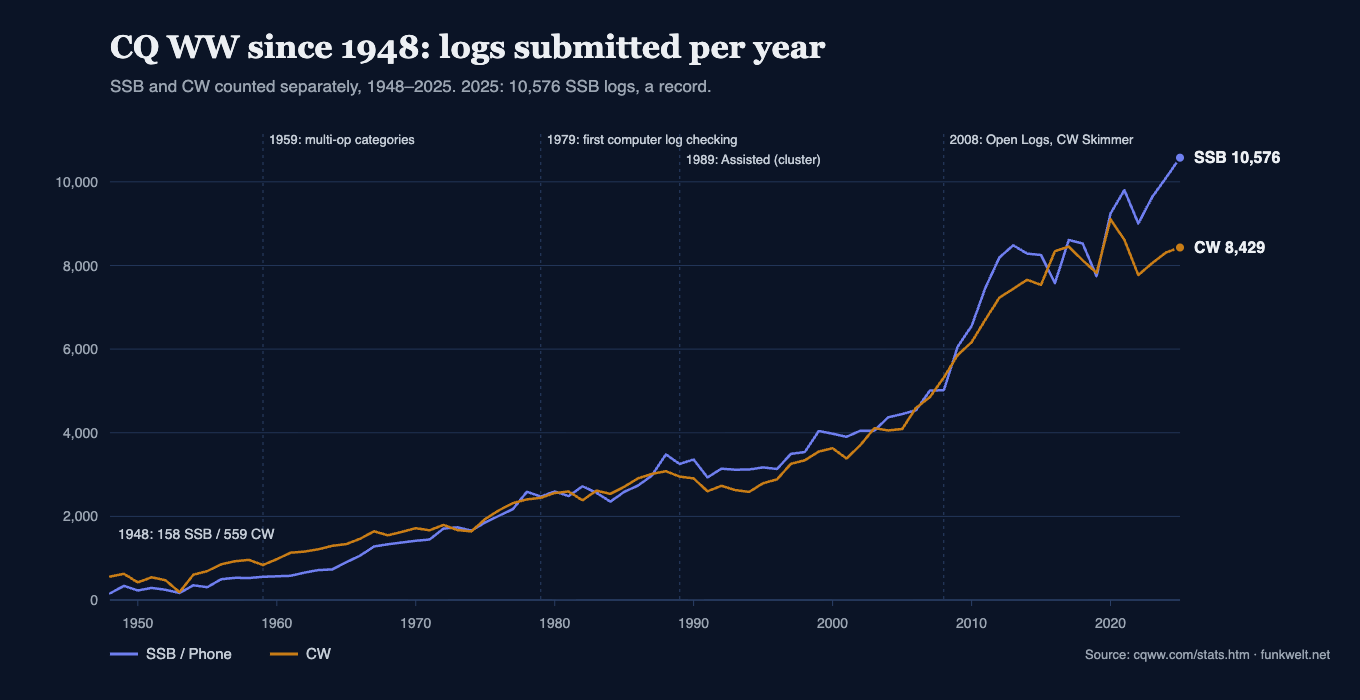
The curve shows how the contest has grown. The categories grew with it: multi-single and multi-multi in 1959, the assisted category for stations using the DX cluster in 1989, multi-two in 2002. 2008 brought two things at once: logs became public, and with CW Skimmer and the Reverse Beacon Network machines began to recognise and report CW signals automatically. From 2009 the curve shoots up.
One rule has a particularly nice story. In 1971 a US multi-single station built an «octopus» station running on several bands at once. The rules only required one transmitter «at the same time», without defining the time. The station scored almost double the others. The 10-minute rule has applied since 1972, and it still does.
Who takes part
2025 brought 10,576 SSB logs, more than ever before, and 19,005 including the CW part. The SSB logs held 5.15 million QSOs between them.
Most logs come from the USA, with about 2,400 SSB logs. Germany follows with 868, then Japan, Italy and Poland. Japan and Russia do noticeably more CW than SSB. Europe provides almost half of all logs, North America just under a third. All of Africa, by contrast, accounts for only 0.6 percent, a mere 45 all-band logs.
World events show up in the numbers too. Ukraine sent 197 SSB logs in 2021, 55 in 2022 and 140 again last year. From March 2022 CQ accepted Russian and Belarusian stations only as checklogs. From autumn 2022 they were scored again but without awards, and since autumn 2024 they have been fully eligible again.
Who wins
If you want to play at the top, you have to go to Africa or an Atlantic island. The world winners of recent years are CN3A (Morocco), D4Z and D4C (Cape Verde), CR3A and CQ9A (Madeira) or P33W (Cyprus). Mostly they are operated by European teams. The reason is in the rules: QSOs with another continent are worth three points, and from there both Europe and North America are within reach. The PJ2T team on Curaçao puts it soberly: Africa will always win.
The SSB multi-multi record is more than 25 years old. CN8WW, a German-led team in Morocco, made 78.2 million points with 25,711 QSOs in 2000. Records still fell in droves in 2025, more than 300 across all categories. EF8R on the Canary Islands made 25.7 million points single-op, a world record. The old one dated from 1999. That has a lot to do with the solar cycle, which peaked in October 2024. 10 m was the band of the year last time.
In the club competition, the Frankford Radio Club leads in the USA and the Bavarian Contest Club in the rest of the world, both for years now.
And Switzerland?
Switzerland sends about 60 logs every year, 59 in SSB in 2025. That is about 0.6 percent of all logs. Until 2014 it was often only ten to twenty, since 2015 clearly more.
The strongest Swiss station for years has been HB9H. It holds the best Swiss SSB score ever: 8.5 million points multi-two in 2002. Last year HB9H was first in Switzerland in multi-single with 6.3 million points. Among the single ops, HB9TOC is the benchmark. And Swiss operators play right at the top too: HB9CAT was on the D4Z team that won multi-multi worldwide in 2022.
Liechtenstein remains a rarity. HB0 sends one or two logs a year. If you work HB0 in the contest, you have a rare multiplier.
New in 2026: what to watch out for
- The log must be uploaded within 48 hours, so by Tuesday, 27 October, 23:59 UTC. Until now you had five days.
- New is a ban on robots. Changing frequency, calling and logging must always be triggered by a human.
- Since 2025 there is the multi-distributed category for teams at several sites in the same country and the same CQ zone.
- Scoring is on 160, 80, 40, 20, 15 and 10 m. The WARC bands stay contest-free; if you want peace and quiet, you’ll find it there.
- The exchange is RS plus CQ zone, «59 14» for us in Switzerland.
- Self-spotting is forbidden. Log checking finds it; 129 stations were caught in 2025.
See you on the air
78 years after it started, CQ WW is bigger than ever, precisely because of computers, the cluster and Skimmer. The core has hardly changed: two callsigns, a report, a zone, and on to the next one. If you only have a few hours next weekend, take part anyway and upload your log. Every log counts, even one with 50 QSOs.
See you on the bands.
Sources
- CQ WW: history, organisation, statistics, records, club scores
- CQ WW rules 2026 and SSB results 2025
- CQ WW: history of the multi-single category
- CQ WW: Russia/Belarus participation
- ARRL: Transatlantic Tests and W2PA: International Relay Party 1927
- NCJ, January/February 2018: PJ2T
- SIDC: solar cycle 25 maximum
73 de Chris, HB9HJI
Leave a Reply