
If you tune across 14.236 MHz in the evening, what you usually hear is: nothing. At most a burbling noise that sounds as if someone were holding a modem up to the microphone. And that is exactly the point — someone is on the air right there, just digitally. FreeDV voice sounds like data garbage in an SSB receiver, and if you do not know that the community meets almost entirely on this one frequency, you keep tuning and think nothing of it.
Since yesterday evening HAM-Tools 1.47.0 has been out, and the app answers precisely this question for you: who is QRV on FreeDV right now — and is it worth listening in?
What FreeDV actually is
FreeDV has been around since 2012, started by David Rowe VK5DGR and his team. The reason for the project still annoys me today: D-Star, DMR and Fusion all use the proprietary AMBE codec — a piece of technology right in the middle of our experimental hobby that we are neither allowed to inspect nor to change. FreeDV is the open answer to that and to this day the only open-source digital voice mode for shortwave.
Things really picked up speed with the new RADE mode, the «Radio Autoencoder»: it sends speech through a neural network instead of the classic chain of codec and modem, and needs around 1.5 kHz to do so. The breakthrough came in February 2026 — RADE was ported from Python to pure C, the software shrank from over 600 MB to 69 MB, and within months apps for Android, iOS and various SDR programs appeared. For the next development stage, which has not yet been released for on-air use, David Rowe quotes an advantage of around 10 dB over SSB — a figure that strikes even him as «a bit too good to be true». Let’s wait and see.
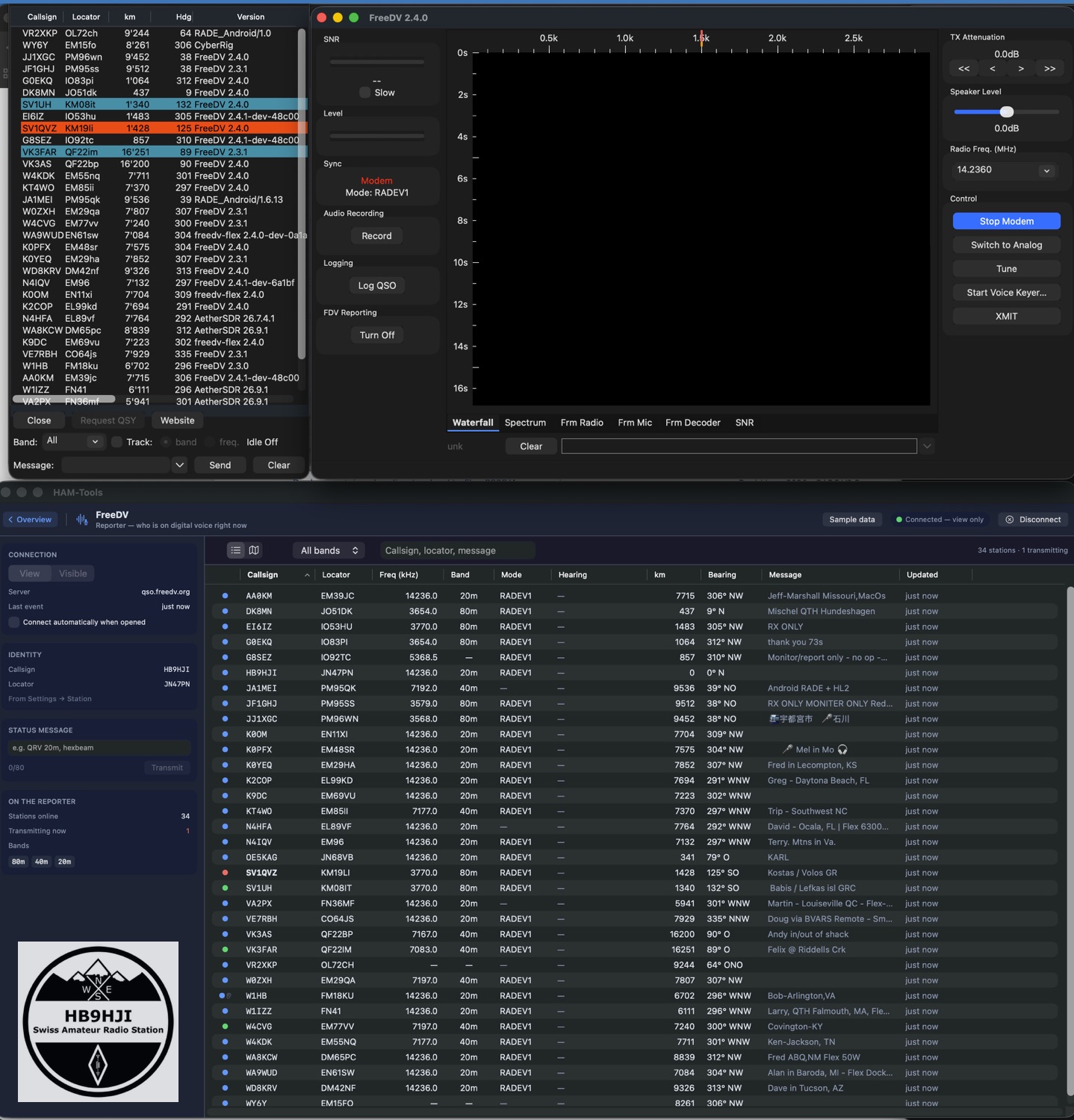
The community is small, and it has a clever habit: its members report each other on a board on the web. The FreeDV Reporter (qso.freedv.org) shows who is online, who is transmitting right now and who is hearing whom with which report.
The board inside the app
That very board is what HAM-Tools now brings into its sidebar. The FreeDV module shows the online stations as a list and on a map: callsign, locator, frequency, distance and bearing from your own QTH. Whoever is transmitting lights up red; whoever is hearing someone shows up green — complete with SNR. Plus band filters, search and great-circle lines on the map. When I connected for the first time yesterday evening, there were between 34 and 40 stations online, a whole pack of them on 14.236 MHz.
Watching, by the way, works without any registration at all. If you set yourself to «Visible», you report your callsign, locator, frequency (which follows the CAT control) and a status message to the Reporter — and then appear on the board yourself. That is how I showed up yesterday as HB9HJI among all the W and VE stations.
The rest fits into the app the way you know it from HAM-Tools: double-clicking a station fills in the QSO form, the CAT switches to the data filter, and the rotator turns to the bearing. And because the Reporter data is ultimately nothing other than spots, it can also run through the DX cluster if you wish — in the spot list, on the band map and on the world map, with its own checkbox to switch it on and off.
The nicest discovery: the feature was already there
Before I started building, there was a feasibility study. The result in one sentence: the greatest benefit for a logbook does not lie in rebuilding the FreeDV decoder, but in making the activity visible and taking over QSOs automatically.
And in the process something came out that made me smile: the connection to FreeDV GUI already existed in HAM-Tools. FreeDV GUI reports logged QSOs via the same UDP protocol as WSJT-X — and the app had long had that receiver on board. All that was missing was the knowledge of it and a field for the ADIF submode. Sometimes the feature is already there, you just have not seen it yet.
Now the chain is complete: if you listen and talk with FreeDV GUI, you press «Log QSO» there, and the contact lands in HAM-Tools — with MODE=DIGITALVOICE and the new ADIF field SUBMODE=FREEDV, just as LoTW and eQSL expect. The live test yesterday evening: K0YEO on 14.236 MHz, cleanly in the log, without a single keystroke in the app.
A curiosity from the protocol came free of charge: one station reported its frequency as 9,223,372,036,854,775,800 Hz — the maximum of an Int64 number, an uninitialised value in its client. In the first test that crashed the app on me. These days that sort of thing is caught; nobody is transmitting on 9.2 quintillion hertz after all.
What the module deliberately is not
HAM-Tools does not decode any FreeDV signal. Listening and talking remain the job of FreeDV GUI — the two programs complement each other instead of competing. The decoder itself is on my list, but I am deliberately not promising any more than that yet.
As far as I know, this makes HAM-Tools the first Mac logbook that shows FreeDV activity live and takes over FreeDV QSOs without retyping. If you know of another one: I am happy to be corrected.
How to try it out
Install FreeDV GUI from freedv.org, tune to 14.236 MHz in the evening — and let HAM-Tools show you beforehand whether it is worth it right now. As always, the app is available as a download; the details are on the help page for the FreeDV module and in the changelog.
After the WSPR module, this is incidentally the second time that a complete operating mode has moved into the app. I simply enjoy it when the logbook does not just record what happened, but shows what is going on right now.
If you try RADE and see me on the board: a wave counts as the first step towards a QSO.
73 de Chris, HB9HJI
Leave a Reply