
In August I wrote here that on 18 November 2026 Voyager 1 would become the first human-made object to be a full light-day away from Earth. Today is that day. According to the trajectory data, it happened at 10:16 UTC, 11:16 local time here in Switzerland.
Around 25.9 billion kilometres now separate the probe from us. A radio signal takes 24 hours to get there. Anyone who sends a command today gets the answer the day after tomorrow at the earliest. JPL project manager Suzanne Dodd puts it quite soberly: you send the message, go home and wait two days.
What has happened since August
The last few months have not been entirely quiet:
- Saving power with the «Big Bang»: In early September the engineers swapped three power consumers on Voyager 1 for more economical ones, as they had already done on Voyager 2. Without this change, according to NASA, the next science instrument would have had to be switched off as early as summer 2027. The radioisotope power source delivers about 4 watts less every year.
- Two days of radio silence: On 18 and 19 October the Deep Space Network received no signal during two planned contacts. On 20 October Voyager 1 was back. A set of thrusters had stopped working, and the probe switched to the backup thrusters on its own. Exactly why is still open. The team itself says that with this mission you now have to expect the unexpected.
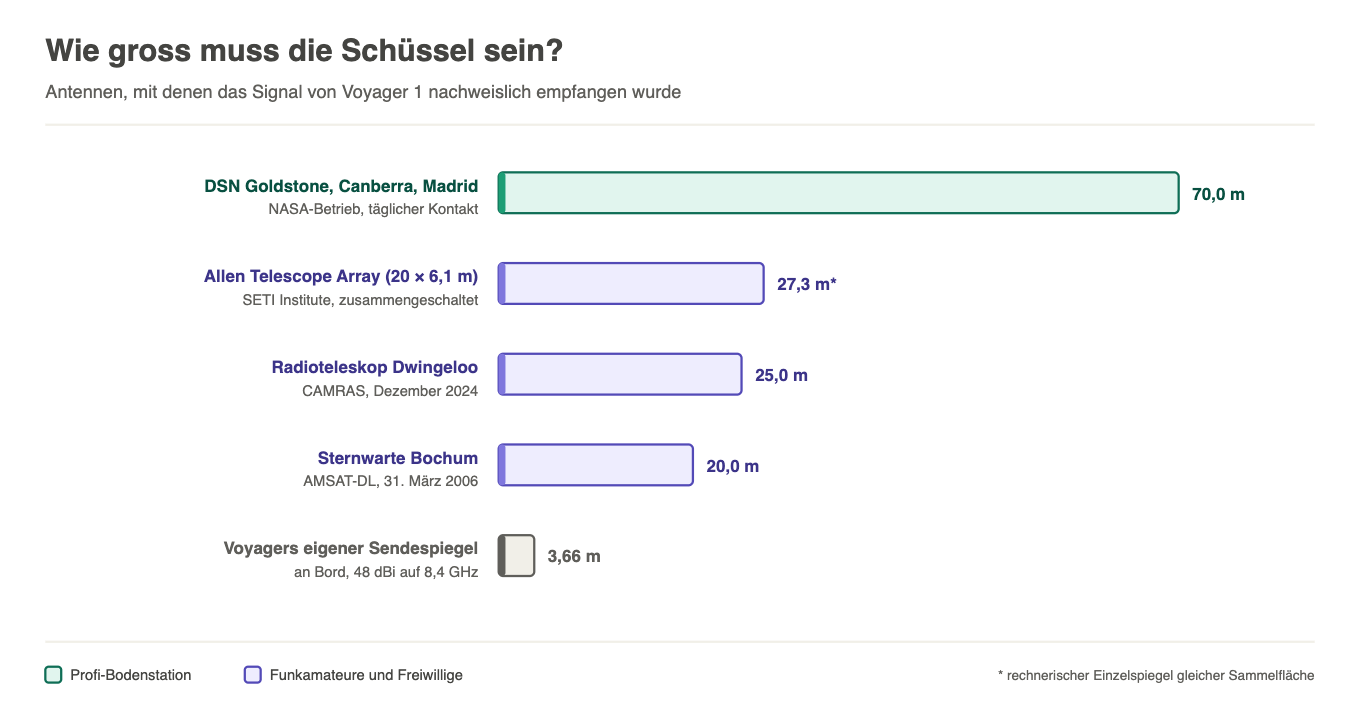
This is where it gets exciting for us radio amateurs: the probe’s 3.66 m antenna has to point at Earth, otherwise nothing arrives. If the attitude is off, the link is gone. With a signal that arrives on the ground at less than an attowatt, there is no margin.
Morse for Voyager
NASA came up with a lovely idea for yesterday evening: under the motto «Shine Bright», people worldwide were invited to flash the letters V G R into the sky in Morse after sunset, with a torch, a phone or a glow stick. That is ···– ––· ·–·. I like the idea that of all things it is Morse that greets humanity’s most distant radio station.
How much longer?
NASA expects contact to last until about 2036. Every year the signal arrives a little weaker because the distance grows, and again and again another consumer has to be switched off. But today, 49 years after launch, Voyager 1 is still transmitting, with about 18 watts, roughly as much as a small mobile radio, from one light-day away.
If you want to read the whole link budget, meaning 8.4 GHz, 48 dBi of antenna gain and which radio amateurs have already heard this signal, you will find it in my post from August (in German).
73 de Chris, HB9HJI
Leave a Reply