
A woman’s voice reads out numbers: five digits, a pause, five more digits, for minutes on end. No callsign, no explanation, no sender. Once you have heard something like that on shortwave, you never forget it. I chase these stations every now and then, with modest success: I have only been really lucky twice. This year, though, the subject has suddenly become topical again, because a new numbers station appeared in 2026.
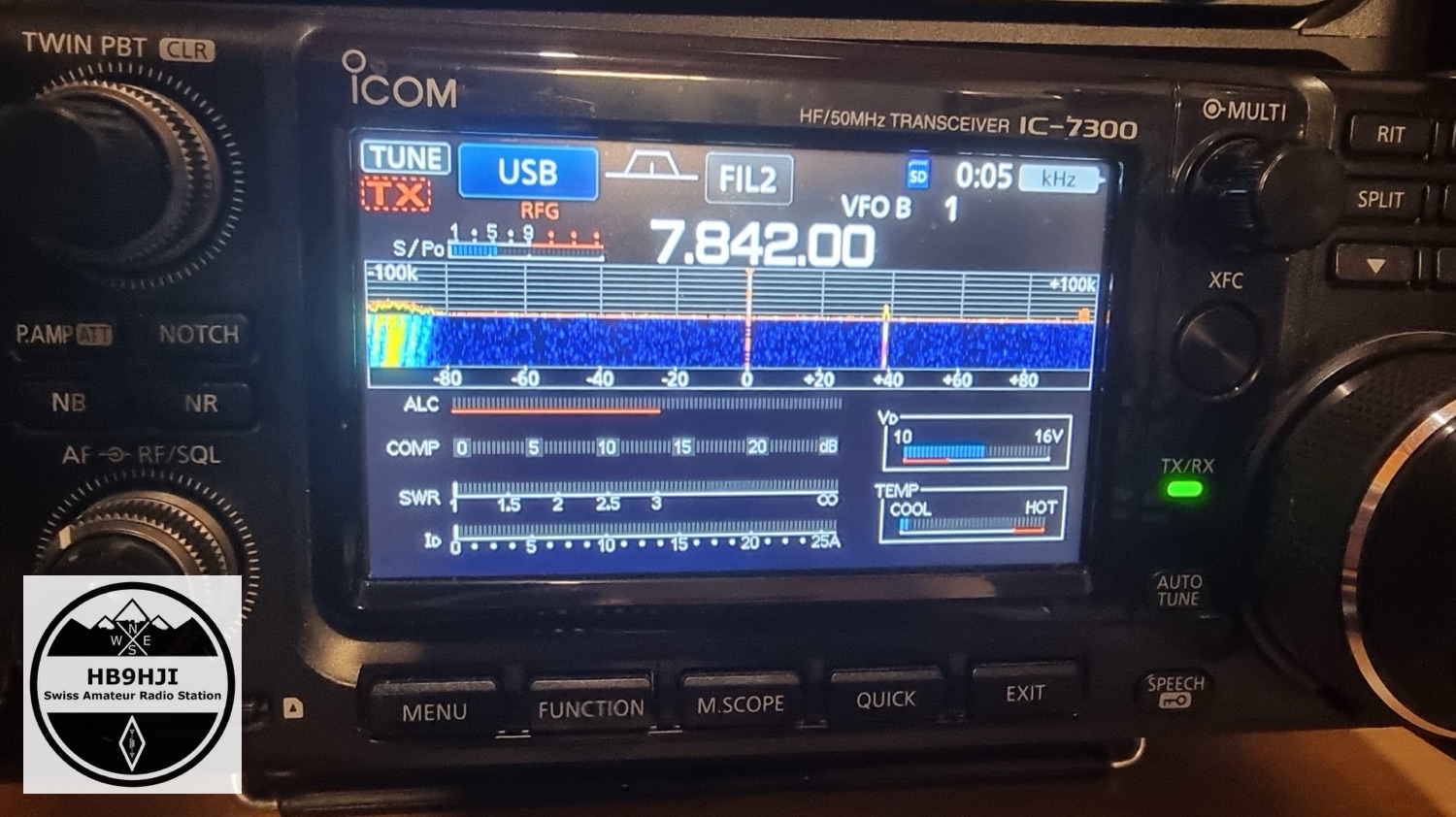
What is a numbers station?
Numbers stations are shortwave stations that send encrypted messages to agents. The sequence is almost always the same:
- An identifier, such as «Attention» and a three-digit number, often repeated for minutes. This gives the listener time to tune in.
- The number of groups that follow.
- The message itself in groups of five, often read twice.
- A closing word, such as «End».
The monitoring scene sorts the stations using a scheme introduced by the ENIGMA group:
- E stands for an English voice, G for a German one, S for Slavic languages and V for all other languages.
- M stands for Morse and F for digital transmissions.
- X stands for oddities and HM for hybrids of voice and data.
Many stations transmit even when there is nothing to say. They then send null messages, so that an adversary cannot tell from the amount of traffic when something is going on.
The newcomer: V32 in Persian
On 28 February 2026 at 18:00 UTC, about twelve hours after the first strikes on Iran, a male voice reading numbers in Persian appeared on 7910 kHz. The scene named the station V32. What followed reads like a spy film:
- From 4 March an Iranian «bubble jammer» sat on 7910 kHz. V32 moved to 7842 kHz, the jammer followed, and the cat-and-mouse game went on for weeks.
- On 7 March, Windows system sounds could briefly be heard in the middle of a transmission. Apparently the transmitter was fed from a perfectly ordinary Windows PC.
- Since 18 March a third version has been running with automated playback. According to Priyom, each transmission consists of six messages of 20 minutes each. Every message starts with «tavajjoh» («attention») spoken three times and contains 181 groups of five digits. It goes out daily at 02:00 and 18:00 UTC in USB, and the 18:00 transmission repeats the one from 02:00.
Who is behind V32 is unknown. Direction finding places the transmitter somewhere in Western Europe. Priyom names a US Army facility in Böblingen near Stuttgart as the suspected site and the CIA as a possible operator. None of this is confirmed, and no government has claimed the station.
Who else is on the air
Numbers stations are not as numerous as during the Cold War, but they are still a daily phenomenon:
- E11 «Oblique» from Poland transmits with a female voice in USB, mostly null messages.
- The Russian stations are the busiest. The monthly reports of «Numbers & Oddities» regularly list E06, S06, the Morse station M14 and many digital transmissions.
- HM01 from Cuba mixes a Spanish female voice with digital data bursts. In recent years, however, it has become unreliable.
- UVB-76 «The Buzzer» on 4625 kHz is strictly speaking not a numbers station but a Russian military channel. It has been buzzing almost without a break for decades, only rarely interrupted by a voice. It is a cult station and a good place for first attempts.
Legends
Some stations have long since become legends:
- The Lincolnshire Poacher (E03) played an English folk tune before every transmission. It is attributed to British intelligence, probably based on Cyprus, and went silent in 2008.
- Swedish Rhapsody (G02) from Poland had a child’s voice read the numbers, accompanied by a music-box melody. It is considered one of the creepiest stations of all.
- The Conet Project is a four-CD collection of recordings from 1997. It is still the reference for numbers stations, and the band Wilco sampled from it.
How the encryption works
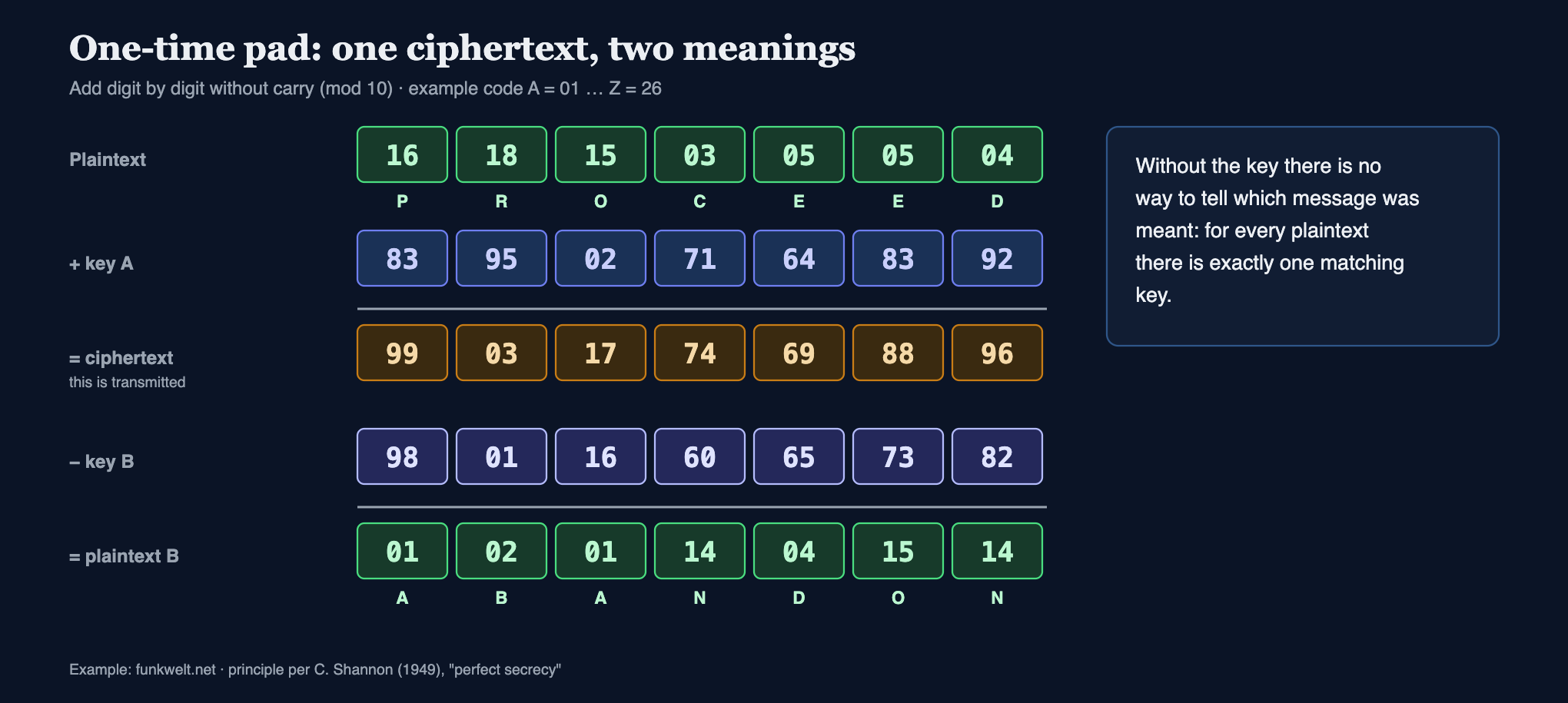
Behind almost all numbers stations is the one-time pad. The agent has a pad of random digits, and every page is used exactly once:
- The plaintext is turned into digits. In practice a table such as the «straddling checkerboard» is used. For my example, A = 01 to Z = 26 is enough.
- The key is then added digit by digit, without carrying. So 7 + 8 = 15 simply becomes 5.
- The recipient subtracts the same key again and gets the plaintext.
That’s all. It needs no computer and no electricity, just paper and pencil.
Can it be cracked?
That was the question that interested me most. Today we have data centres, graphics cards and powerful AI. Can they decrypt a V32 message?
The answer is no, and not because the computers are too slow. It is down to the mathematics. The graphic above shows the core of it: for the same ciphertext there is exactly one matching key for every conceivable plaintext. «PROCEED» and «ABANDON» produce the same ciphertext, just with a different pad. Anyone who tries every key does not find the one right answer but all possible messages at once, and nothing tells them which one was meant. Claude Shannon proved this in 1949. It is called «perfect secrecy».
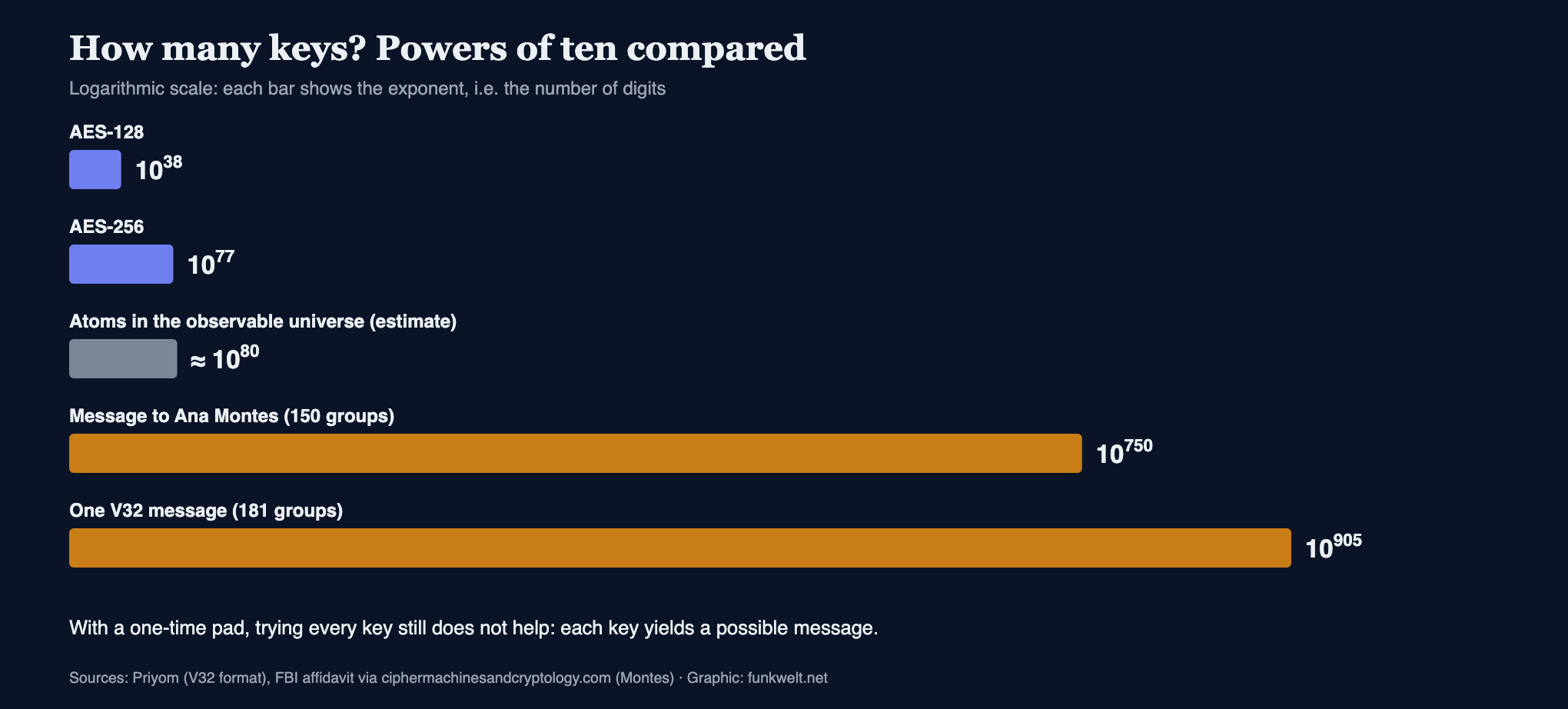
A few numbers: a single V32 message has 181 groups of five digits, so 905 digits. That gives 10⁹⁰⁵ possible keys. For comparison: AES-256, a current standard for secure connections, has «only» about 10⁷⁷ keys, and the whole observable universe contains an estimated 10⁸⁰ atoms.
And an AI? I asked Claude. The answer was honest: an AI recognises patterns, and a true one-time pad has none. The ciphertext cannot be told apart from pure chance. An AI could at most invent a plausible-sounding message, but with a one-time pad you can do exactly that with any message you like. Quantum computers change nothing either. With AES and RSA, security is a matter of computing effort. With the one-time pad there is simply nothing to compute.
They got caught anyway
Numbers stations were never broken mathematically, always through human error:
- Venona: Under pressure from the German advance on Moscow, the Soviet Union printed some 35,000 pages of key material twice in 1942. The Americans noticed. By 1980, out of hundreds of thousands of intercepted messages, they were able to read about 3,000 in whole or in part, and only because pages had been used twice.
- Ana Montes: The analyst at the US Defense Intelligence Agency (DIA) spied for Cuba for years. Her instructions came by shortwave, 150 groups of five per message, and she decrypted them with a program on her laptop. That was her mistake. The FBI secretly copied the hard drive and found deleted remnants of a message that exactly matched an archived 1999 broadcast. She was arrested in 2001. Such broadcasts also played a role in the case of the so-called «Cuban Five».
The lesson: the mathematics holds. It gets dangerous when keys are used twice, when the randomness is not really random, or when the key sits on a computer that someone else gets hold of.
Listen for yourself
If you want to try it yourself, priyom.org has current schedules and direct links to WebSDRs. Numbers & Oddities publishes logs as a PDF every month. For V32 it is 18:00 UTC on 7910 or 7842 kHz in USB. You can find the Buzzer on 4625 kHz at any time.
There is a catch, though, and we radio amateurs know it well. V32 is located in Western Europe, perhaps only about 150 km from me. In the evening the critical frequency of the ionosphere above us is around 3 MHz. A signal on 7.9 MHz sent steeply upwards then simply goes straight through instead of coming back down. It only becomes audible much further away, and listeners in Greece or Cyprus do indeed report strong signals. So it is quite possible that we in eastern Switzerland sit in the skip zone. Priyom also reports that V32 has become much weaker since the end of March. A WebSDR further away helps here.
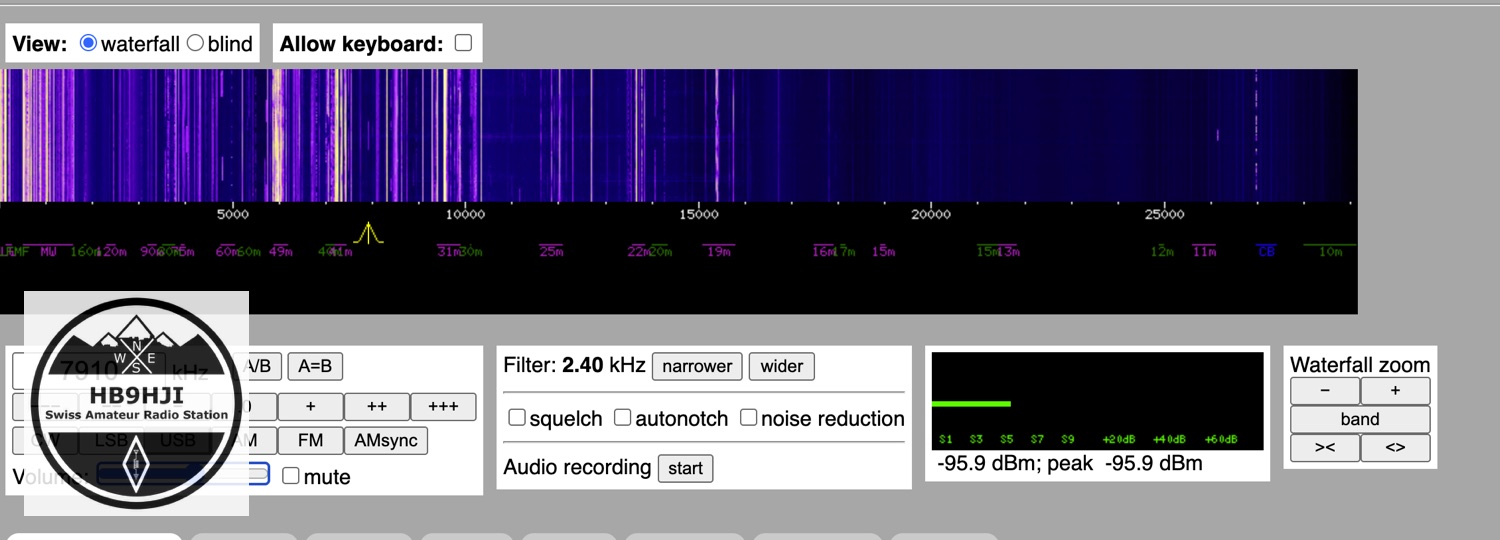
I will listen in again at 18:00 UTC over the next few days and report back on whether it worked.
By the way: if you want to compare receiving antennas, numbers stations are a kind of beacon. Times and frequencies are fixed, and you can, for example, switch between two antennas on the same transmission.
Numbers stations are one of the last real mysteries on shortwave. The technique behind them dates from the last century, and yet it is still uncrackable today. I simply find that fascinating.
73 de Chris, HB9HJI
Leave a Reply